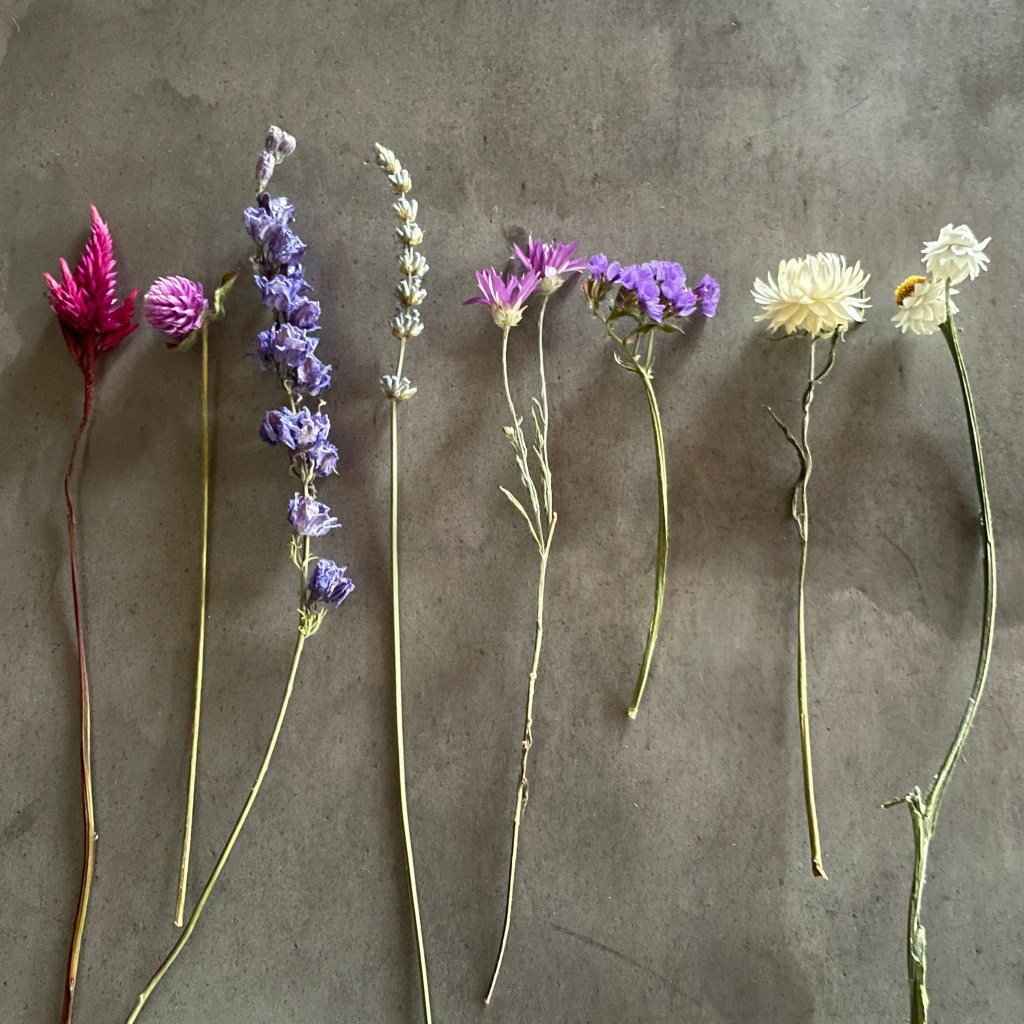
Here are the flowers I’ve been drying this summer, all of which keep their color and shape well as they dry. The stems pictured above are in the same order, from left to right, as the list. After learning about each flower, you can read on for some general tips on drying and arranging these dried blooms.
Celosia (Celosia argentea): The plume-shaped flowers of this celosia come in a wide range of colors, from lime green to coral to crimson, and all of the brighter and darker colors keep well when dried. Celosia flowers continue to grow as they mature, and they can be cut whenever the flower is the size you want for arranging, though the dried stems will be less weak if you wait until the flower has matured a bit. Another species that I have yet to grow that’s used for fresh or dried cut flowers is Celosia cristata.
Globe amaranth (Gomphrena globosa, Gomphrena haageana): Globe amaranth branches out into nice, bushy plants without needing to be pinched when it’s a seedling, and its papery, round blooms dry quickly. It’s helpful to cut them before the flowers have started to fade but after the stems have stiffened up, because otherwise they may be too weak to arrange with.
Larkspur (Consolida ajacis): Larkspur’s spike-shaped flower stems hold their color well when dried. I typically harvest larkspur for fresh use when its flowers are just beginning to open, and for dried use when they’re already mostly open. One note: this is a poisonous plant.
Lavender (Lavandula angustifolia, Lavandula x intermedia): These two species of lavender make lovely, scented dried stems. I’ve described them in detail here.
Paper Flower (Xeranthemum annuum): This summer annual produces dainty, round flowers, on branching stems that are thin but hold up well for dried bouquets. To cut for drying, wait until most of the flowers on a group of stems have opened.
Statice (Limonium sinuatum): What might first appear to be the flowers of statice are actually its bracts, which have a papery texture and hold their color well when dried. The flowers are tiny and found within each bract, and as you dry the stem the flowers disappear. Other species of statice that are known to be great as dried flowers (and which I have yet to grow) include Limonium suworowii and Limonium tataricum.
Strawflower (Helichrysum bracteatum): Like globe amaranth’s stems, strawflower stems can be floppy and a bit weak for arranging with once they’ve dried. I typically cut some stems a bit earlier, when the flowers only have a few rows of open petals but the centers are closed; these will look pretty when dry but their stems may be too weak for arranging, so I use them in crafts like holiday garlands and ornaments. Stems cut later may be stronger and useful for arranging but will usually have flowers with more open centers.
Winged Everlasting (Ammobium alatum): Winged Everlasting has branching stems with cute white flowers that open to reveal a yellow center; for drying, the stems are typically cut before the blooms have fully opened, because the yellow center often darkens as it dries.
To dry these flowers, tie them in a bunch with twine or a rubber band, and hang them upside down in a dark and dry spot for a few weeks. Once the stems have dried, handle them with care as you separate the bunches and begin to arrange them, since they become fragile after drying. Inevitably, you’ll end up with some flower debris that falls off as you work with them, but it’s easy to sweep up and send outside.
When creating mixed bouquets, I typically combine stems with a variety of shapes: statice as filler, lavender or larkspur as spikes, globe amaranth or strawflower as rounded blooms, and paper flower or winged everlasting as delicate branching stems.
 Local flowers from St. Helena, CA