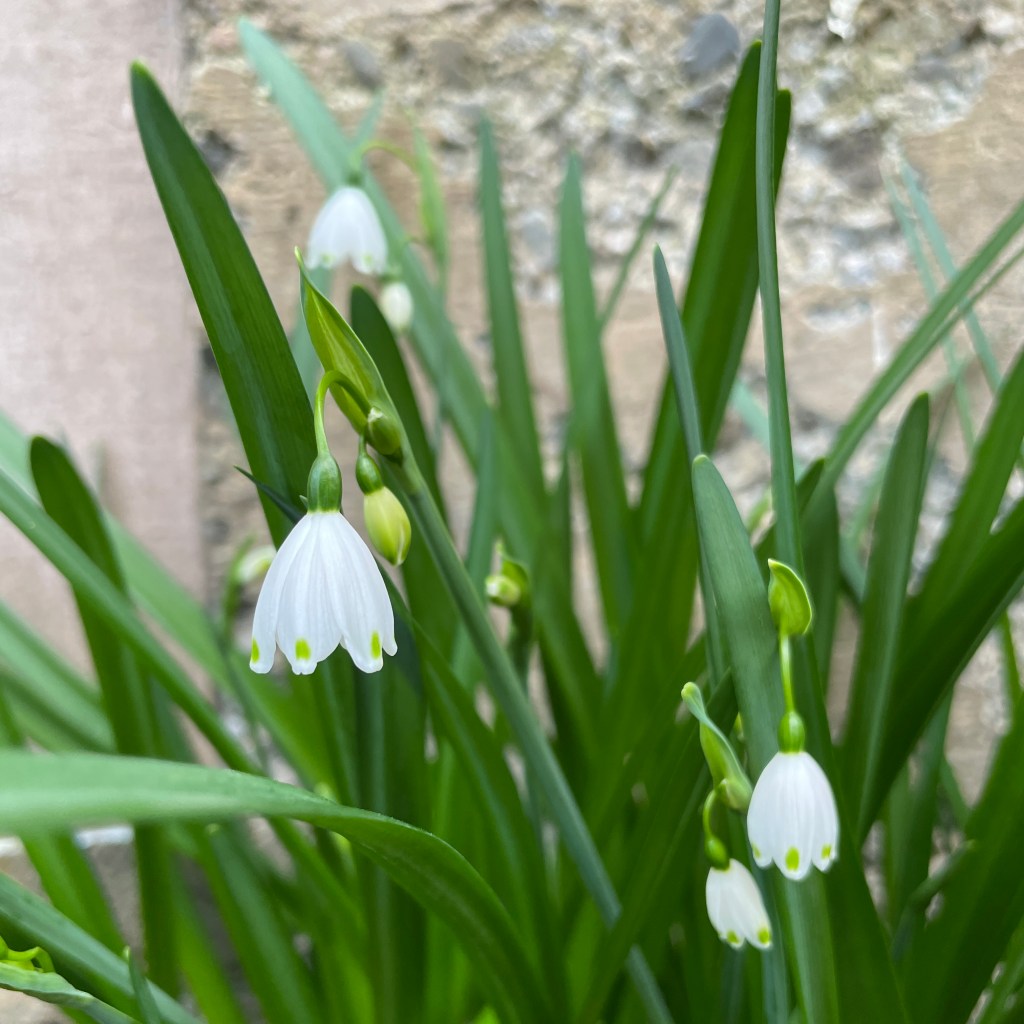
Leucojum aestivum is a spring bulb native to Europe that sends up multiple flower stems. Each stem has several white, bell-shaped, pendant flowers with a delicate form and a tiny green dot on each of its tepals. Though Leucojum plants are often called “summer snowflakes” and their Latin name contains the word “aestivum” (“of the summer”), they are spring bloomers, and in our garden they often start flowering in January. To bloom, Leucojum needs moist soil during its growing season, so it thrives in soggy spots during chilly, wet winters here, and it can handle hot, dry summers. Like Narcissus, Leucojum is not attractive to critters.
Another trait shared with Narcissus is that Leucojum flower stems leak sap when they are first cut. Since this sap can shorten their vase life, and that of any other flowers in an arrangement, it’s helpful to change the water a few times for the first day after cutting them. And don’t re-cut the stems when arranging, as this can cause more sap to begin flowing. To get the longest vase life, cut Leucojum when the first flower on a stem has begun to open. If these tips are followed, you can expect it to look good for about 6 days in the vase.
If you’re growing Leucojum for cut flowers, consider planting the cultivar ‘Gravetye Giant’, because it’s taller and more robust than the species. It’s named for Gravetye Manor, the home in England of gardener William Robinson, who carried out an innovative approach to studying and using plants during the Victorian and Edwardian eras. With the goal of expressing wildness in a cultivated setting, Robinson utilized techniques like naturalizing drifts of flower bulbs.
To naturalize bulbs means to encourage them to return each year and spread out in a naturalistic-looking manner over time. If you have a spot at home that gets plenty of moisture during winter rains, you may be able to naturalize Leucojum yourself. And if not, forcing it indoors in a pot is also an option.
 Local flowers from St. Helena, CA